

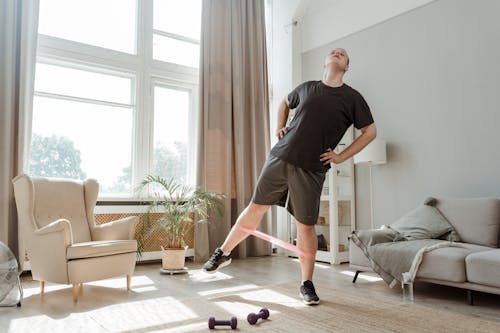
Overall 39% of the grown-ups were overweight in 2016, as per insights of the World Health Organization. In the US the pervasiveness of weight was 42.4 percent in 2017/2018, as indicated by an overview of the National Center for Health Statistics (NCHS).
Simultaneously a large number of individuals need to get in shape. Actual exercise is a significant choice to accomplish this. All things considered, a greater number of calories are burned through sport than when sitting, standing, or resting.
Yet, what impact in all actuality does don have on (direct) dietary patterns? Researchers at the Technical University of Munich (TUM) and the University of Nebraska (USA) have now explored this inquiry interestingly.
Randomized review
"In the games setting, we have the peculiarity of individuals indulging later active work," said Prof. Köhler, Professor of Exercise, Nutrition and Health at the Technical University of Munich. "Individuals need to remunerate themselves and their bodies for being dynamic. So we utilize a speculative investigation to discover the reason why individuals eat more later exercise contrasted with when they don't work out."

The point of a randomized hybrid review was to research the impact of activity on theoretical choices with respect to the sum and timing of food admission. For this reason, 41 sound members (23 ladies, 18 men) matured somewhere in the range of 19 and 29 years with a normal BMI of 23.7 were haphazardly doled out to either a 45-minute exercise meeting or a rest time of equivalent term at the primary visit and finished the other review condition at the subsequent visit.
Abstract evaluation of appetite and satiety
For each situation, the preparation bunch addressed an electronic poll before the active work about their emotional evaluation of craving and satiety, favored measure of food to eat, and decision between food varieties that contrasted in planning of utilization. Subjects showed their food amount inclinations by posting their ideal part size of every food. Inclinations were gotten for both quick and later utilization of the food following four hours.
Subsequent to noting the principal survey, members performed 45 minutes of high-impact practice on a bike ergometer. Promptly thereafter, they finished the electronic poll a subsequent time and afterward a third time following a 30-minute break. The technique for the gathering without preparing was indistinguishable; rather than 45 minutes of active work, these members had a rest break.
Contrasted with the rest break, practice gave a more noteworthy expansion in how much food picked, both following activity and 30 minutes a short time later. Active work likewise brought about a more prominent expansion in inclination for guaranteed food utilization both following activity and 30 minutes a short time later.
Weight reduction through work out
"In view of this review, we had the option to show interestingly that specific qualities, like the sum and 'criticalness' with which an individual needs to eat, shift over the direction of actual effort," said Prof. Köhler, arranging the outcomes. "These discoveries assist us with growing new mediations to streamline weight reduction through work out."
"The genuine outcomes propose that actual effort can captivate the individuals who truly do game to eat bigger measures of food all the more rapidly later the instructional course," says Prof. Köhler. "Since weight reduction is a primary inspiration for practicing for some, and inability to accomplish the ideal weight reduction makes it liable to stop working out, it very well may be a decent technique to contemplate what you need to eat subsequently before you begin to work out."
How powerful these and other potential systems work, how they can work on long haul consistence with preparing projects and add to positive wellbeing results through weight reduction and regardless of whether the impact may ultimately wear off, is the subject of the flow examination of the researchers.
Reference: "Exercise Shifts Hypothetical Food Choices toward Greater Amounts and More Immediate Consumption" by Karsten Koehler, Safiya E. Beckford, Elise Thayer, Alexandra R. Martin, Julie B. Boron and Jeffrey R. Stevens, 24 January 2021, Nutrients.
The BMI is the most well-known recipe for working out weight. It is determined by squaring the proportion of body weight in kilograms and stature in meters. Values somewhere in the range of 18.5 and 24.9 are viewed as ordinary weight.


0 Comments